Cheers Hub: Redesigning Digital Employee Experience at Global Scale
Client AB-InBev
Agency Livework São Paulo
Years 2013-2025 (Ongoing)
Team I led product design, collaborating with service designers in discovery and strategy, working solo in initial implementation, and later partnering with another product designer
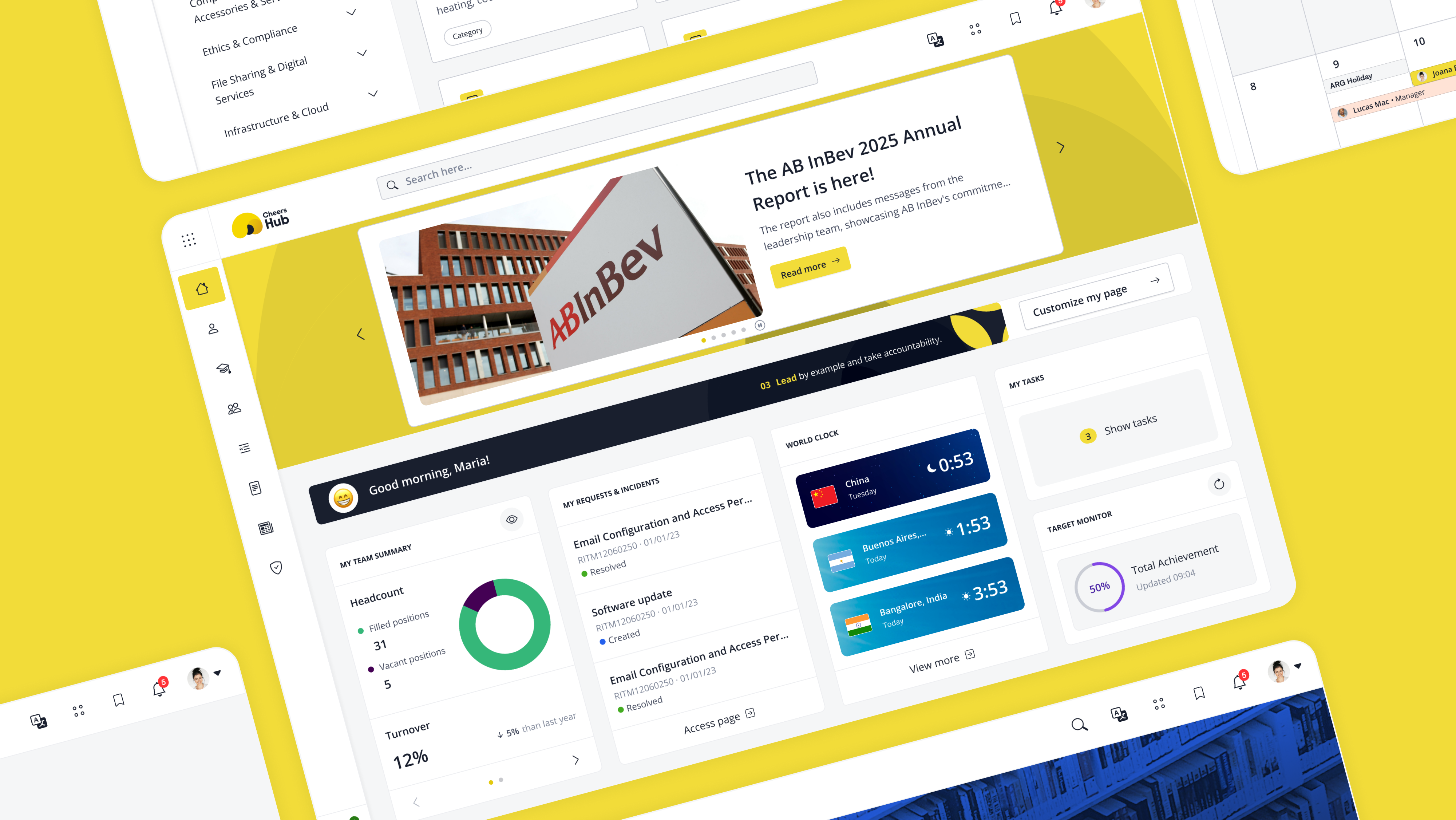
Overview of the home page.
Summary
AB-InBev (Anheuser-Busch InBev) is the world’s largest brewery, operating in 140 countries with more than 160,000 employees. In this scenario, AB-InBev invited Livework to evolve Cheers Hub, its employee platform, into the company’s primary hub for interaction, information, and services.
After a thorough discovery phase, we identified the main needs throughout the employee journey and prioritized solutions with the potential to generate immediate and measurable impact. These insights were the starting point for Cheers Hub’s roadmap, which guided the new version of the platform and aimed to enhance employees’ digital experience, allow the decommissioning of redundant systems, and optimize the work of the People Business Partners.
Building on these priorities, I helped turn the strategy into a tangible digital product with redesigned information architecture, UX strategy, design system, and UI patterns. These definitions support our continuous evolution of the platform, consistently releasing new features in an agile environment, in close collaboration with Technology, People, and Business areas.
After over two years of continuous partnership, Cheers Hub has scaled from a regional pilot to a global platform used in 55 countries by over 50,000 active employees. Employee satisfaction surged, usability metrics reached industry-leading levels, and the Design System extended across People & Tech platforms, boosting consistency and development efficiency. By replacing legacy systems and reducing operational demands, the platform improved productivity, empowered People Business Partners, and established a strong foundation for sustainable innovation.
My role
Working both independently and in collaboration with the team, I was responsible for:
- Discovery: Conducting research through interviews, usability tests, workshops, and heuristic analysis, then mapping employee journeys and developing personas to guide design decisions.
- Stakeholder alignment: Gathering requirements and validating deliverables with People, Tech, and Business teams.
- UX and UI Design: Defining information architecture and designing mobile, tablet, and desktop prototypes for end-to-end feature development, then organizing developer hand-offs of screens and user stories, and conducting quality assurance within an agile environment.
- Design System Ops: Structuring, documenting, and scaling a Design System for consistency and efficiency.
Full case study ︎︎︎
Context
After a rapid growth, overlapping employee management tools emerged across different business units, creating inefficiency and a fragmented employee experience. Cheers Hub was conceived to address this challenge, aiming to centralize processes and information across the employee journey.
During its pilot launch, gaps in both strategy and user experience became evident, limiting its potential. In face of these barriers, the project set out to rethink the platform and redesign the experience to meet AB-InBev’s business and employee needs.
Discovery & Strategy
With the team, I conducted global employee research through interviews and mapped the employee journey to understand the employee experience, workplace tools, and expectations for Cheers Hub. This uncovered cultural barriers, distrust toward platforms, and critical pain points, especially in the “Daily Work”, “Excel & Grow”, and “Manage My Team” phases of the journey.
24 interviews with employees and stakeholders in 8 seniority levels, across 6 business areas in 4 continents
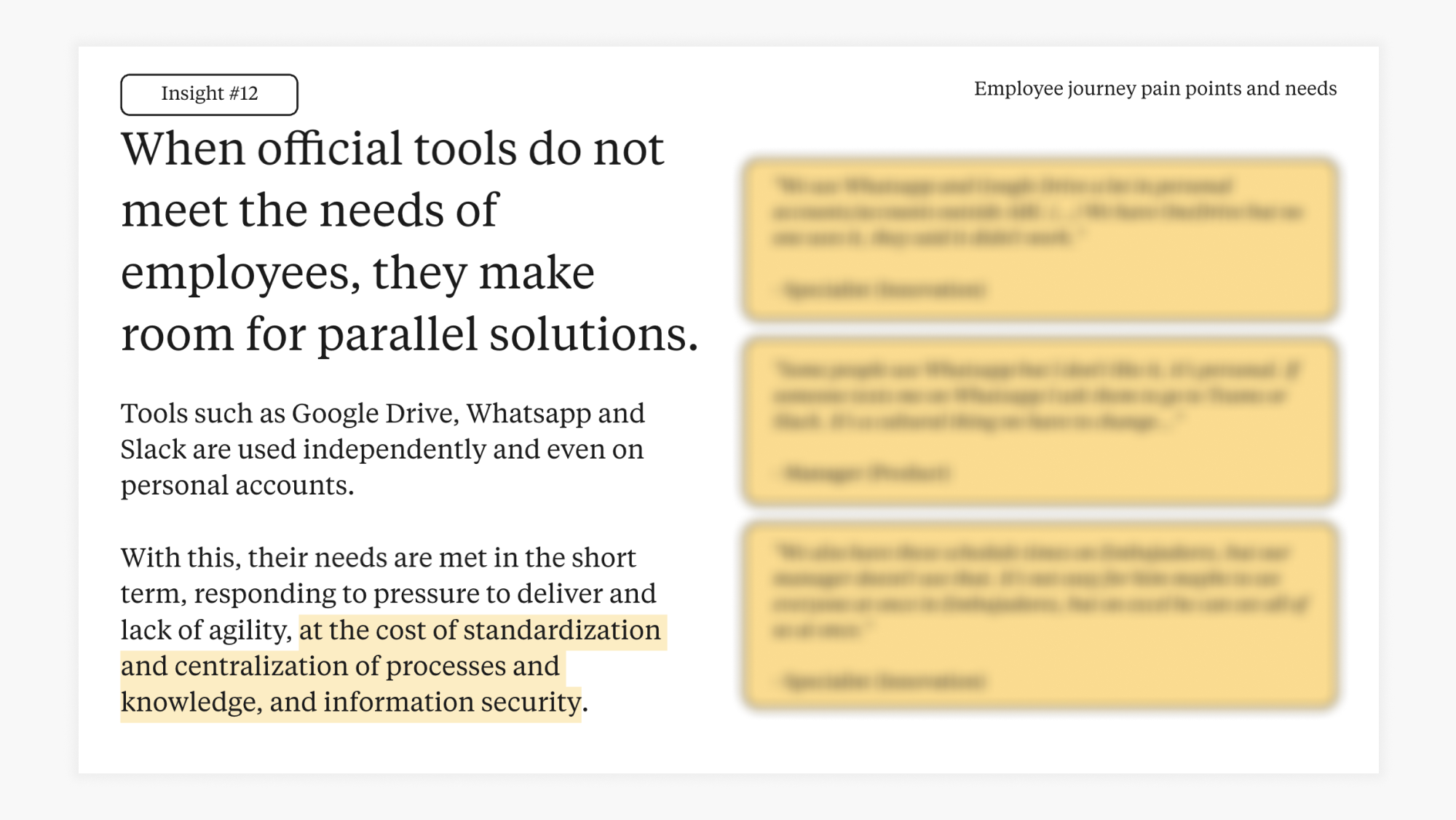
Example of interview insight.
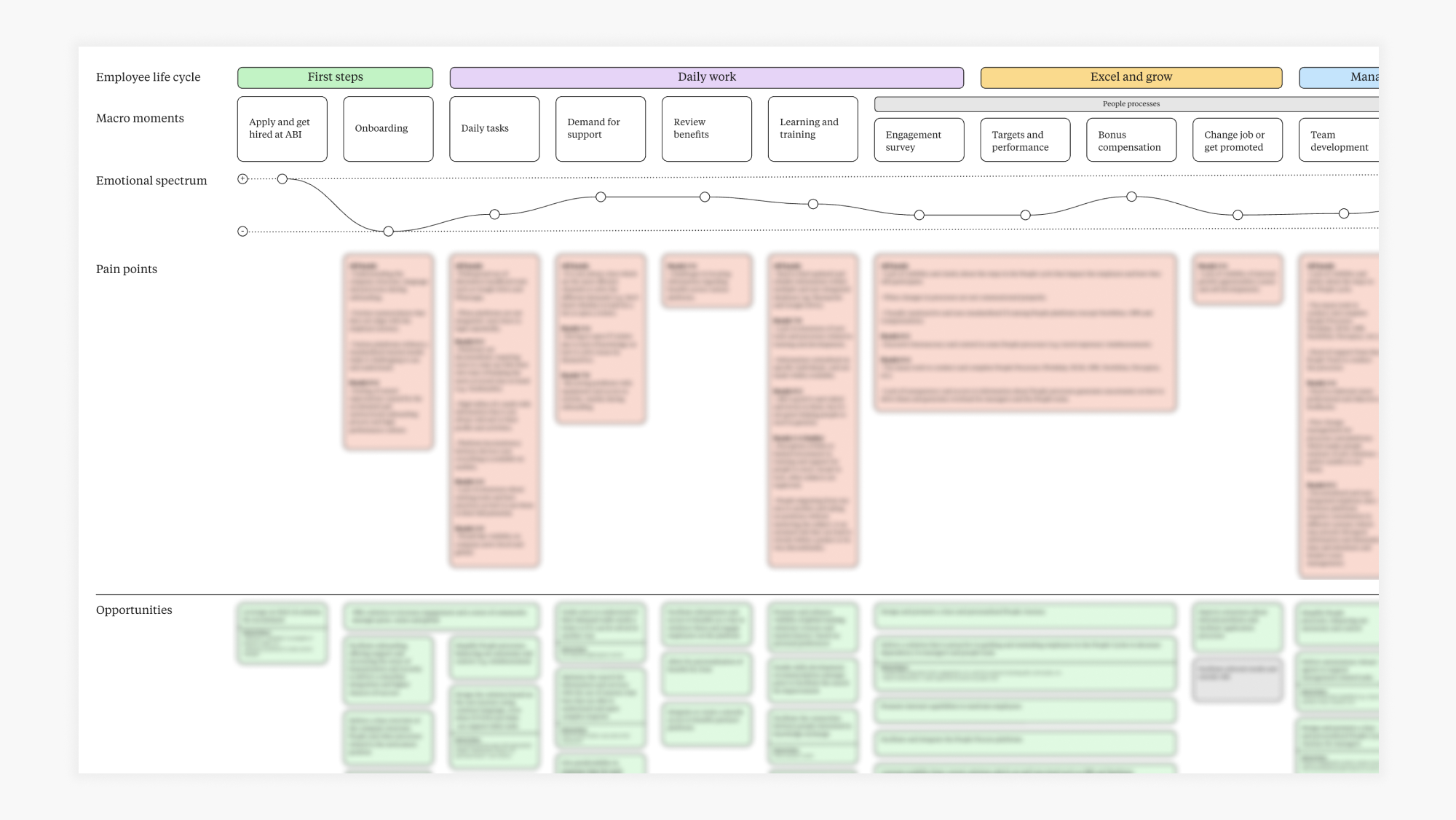
Excerpt of the AB-InBev employee journey map.
From these findings, we created personas representing key employee groups, and I evaluated the existing Cheers Hub with heuristic and benchmark analyses. This revealed major usability issues and missed opportunities, which directly informed roadmap priorities and laid the foundation for redesign.
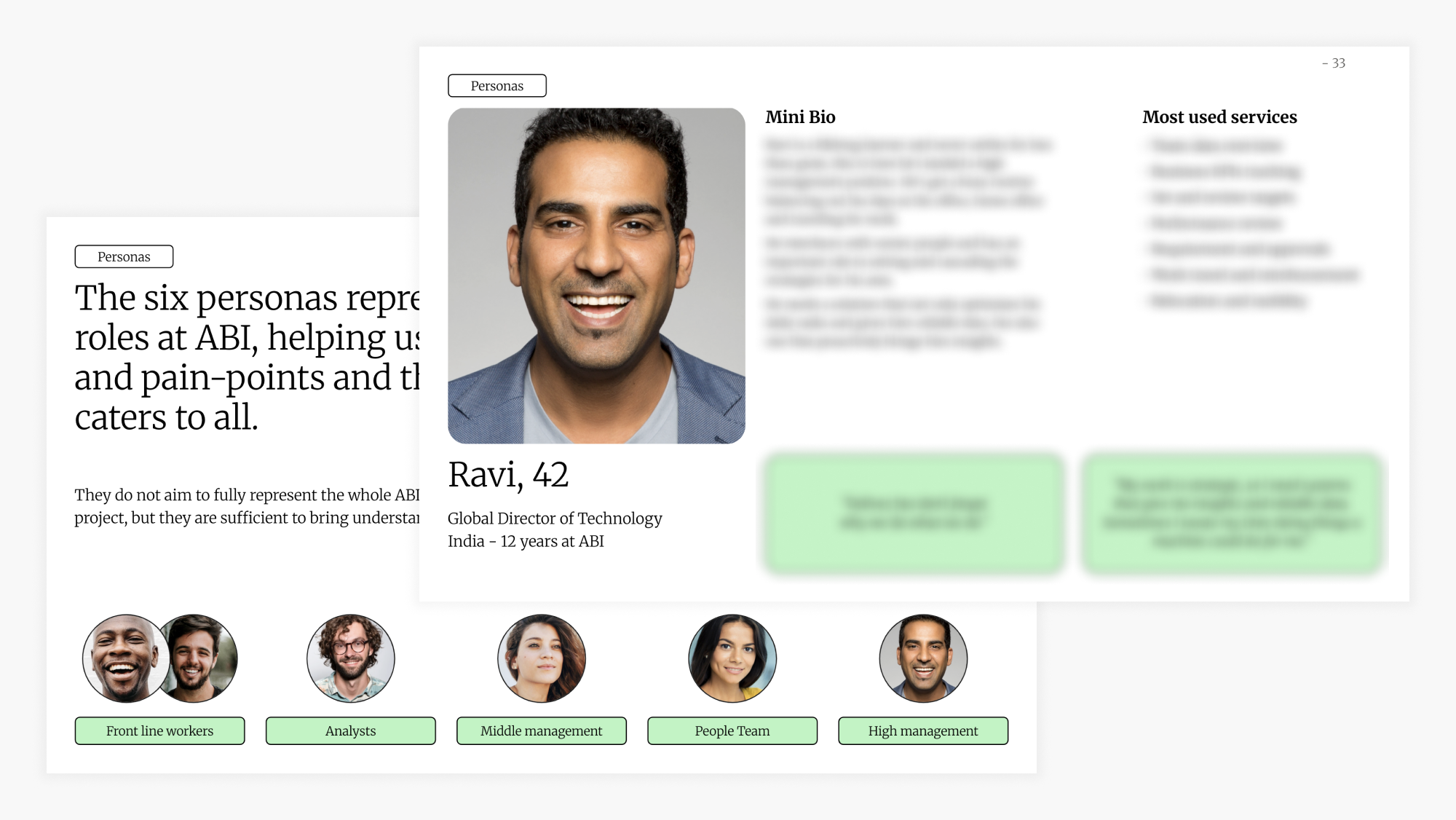
Example of an employee persona.
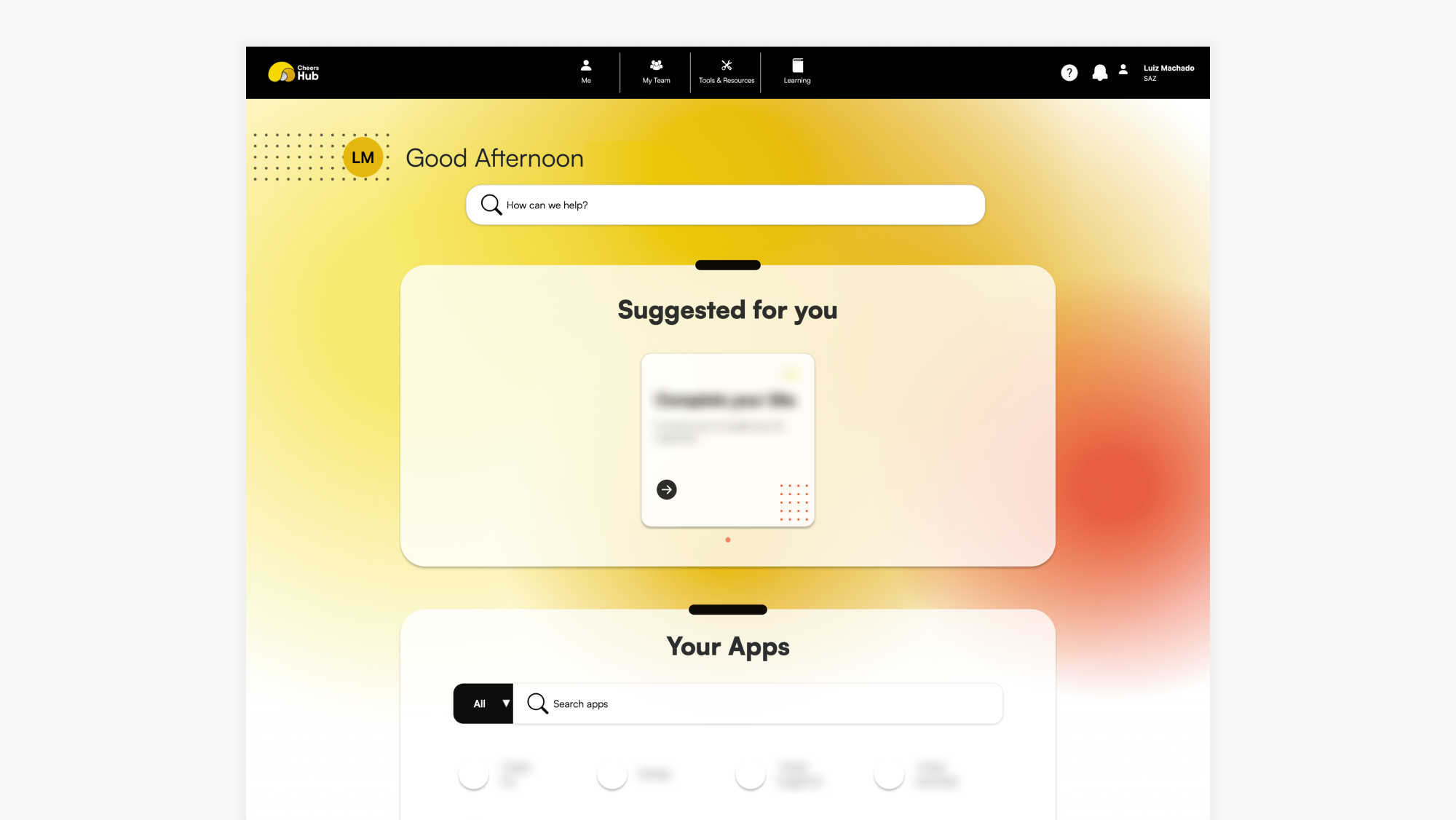
Home page of the previous version of Cheers Hub.
In partnership with People and Tech teams, we defined a new UX strategy, value proposition, and strategic pillars. This strategy guided roadmap decisions and positioned Cheers Hub to evolve into a one-stop-shop for tasks, knowledge, collaboration, and growth, balancing employee needs with business goals.
Implementation
To translate the vision for Cheers Hub into a tangible, fully responsive product, I focused on designing its core foundations, which allowed us to release new features in alignment with the roadmap.
Information Architecture
MAIN NAVIGATION
Challenge: The platform’s navigation was confusing, with too few menus, inconsistent naming, illogical sequencing, and mismatched labels.My Solution: I designed a journey-based navigation, split into a top menu with utilities and a side menu with workflows, leaving room to scale - reorganized and rewritten with consistent wording for faster wayfinding and reduced cognitive load.
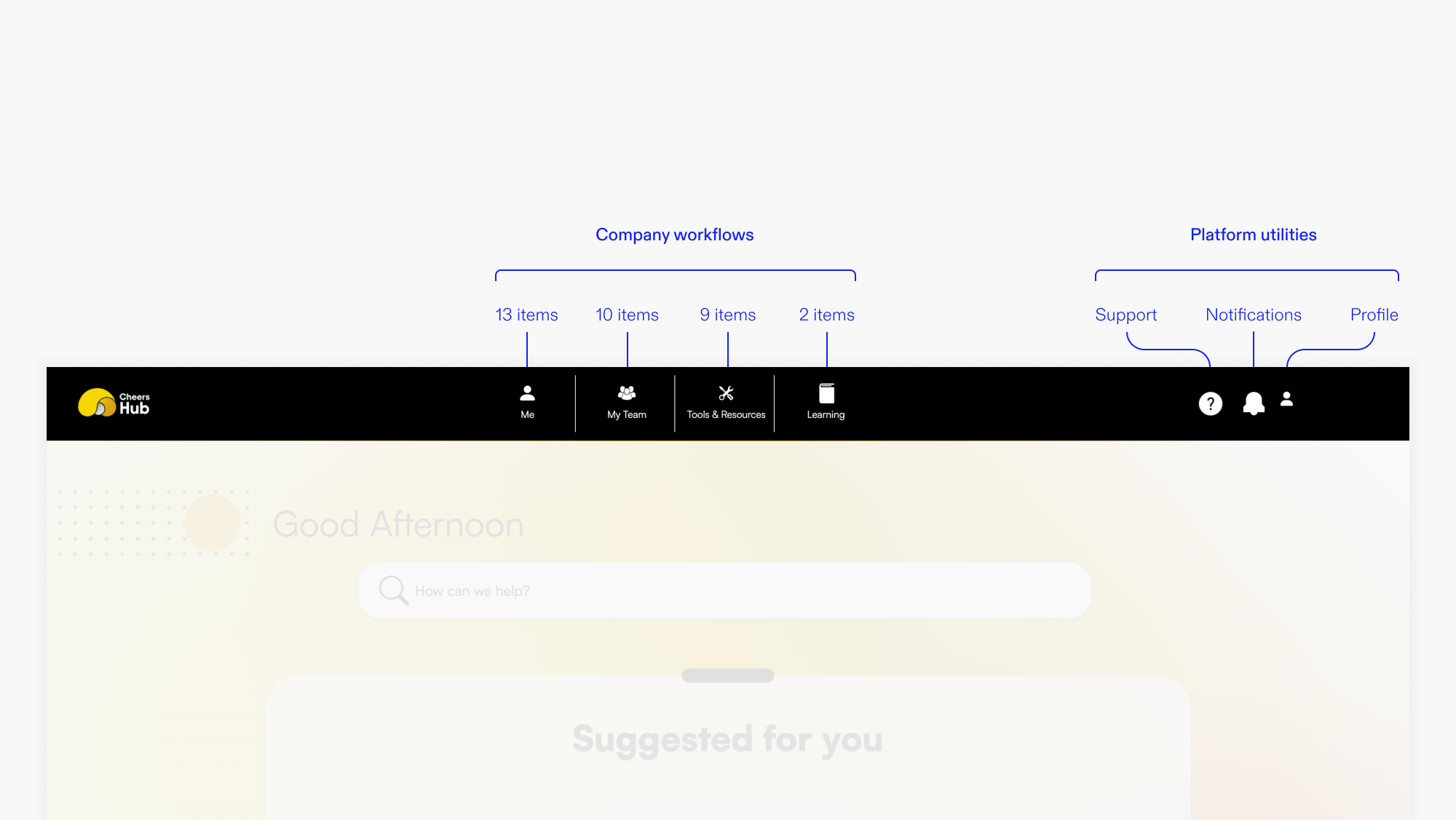
Main navigation before.
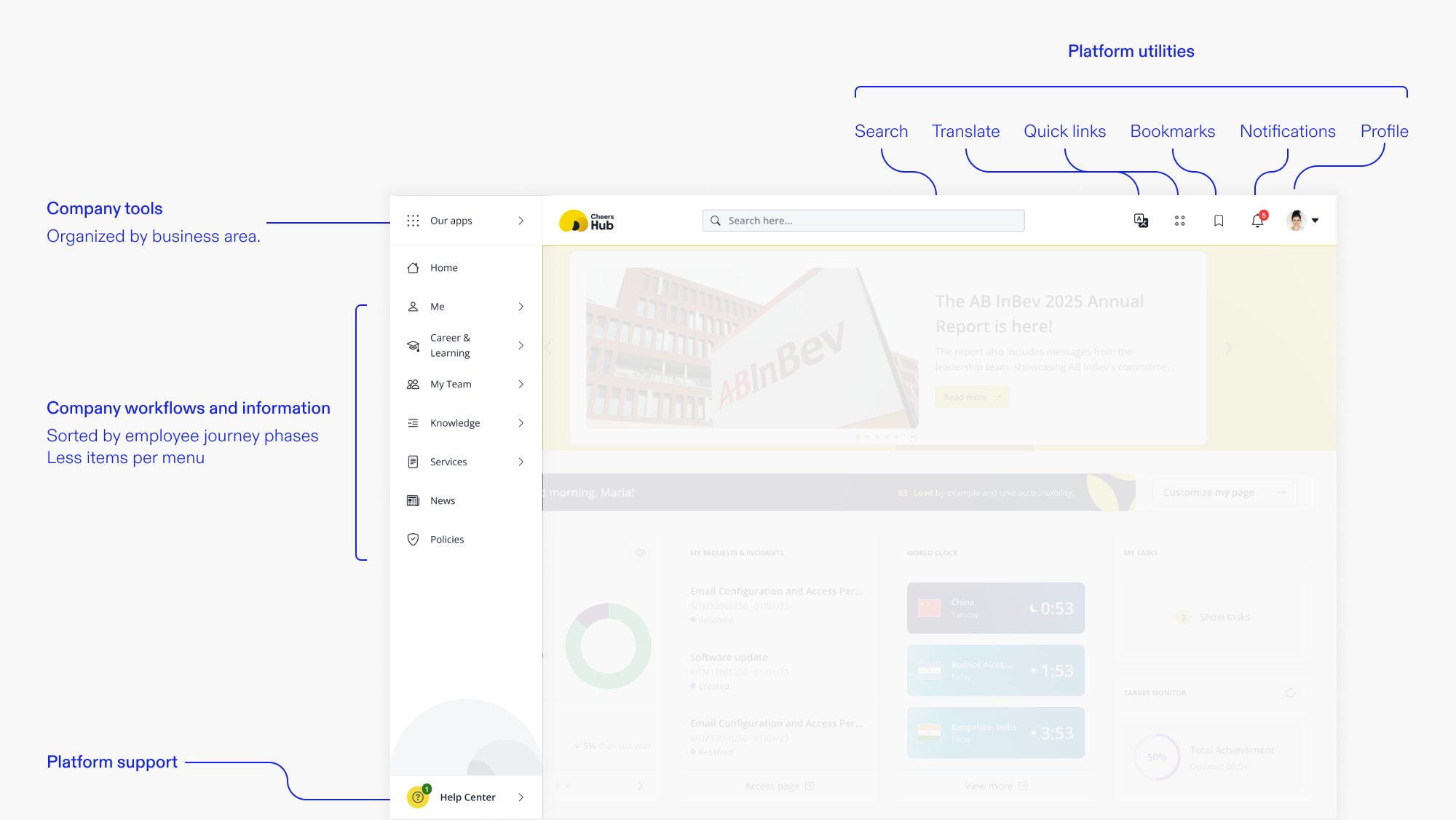
Main navigation after.
HOME PAGE
Challenge: The home page was severely underused, serving as a simple gateway to other features.My Solution: I reframed the home page as a central console by adding key services and information so employees can start their day fully equipped, without constantly switching between different pages.
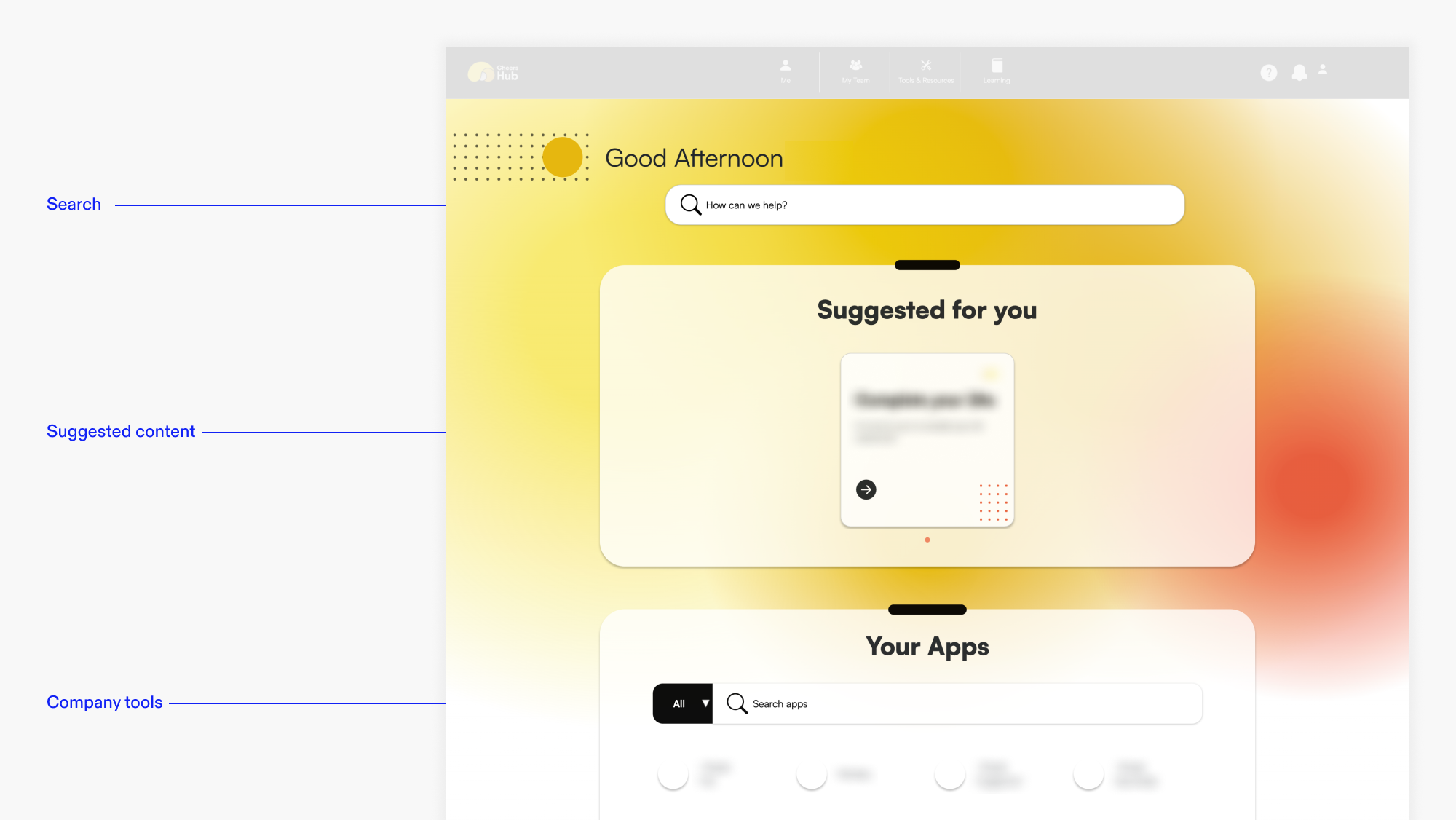
Home page before.
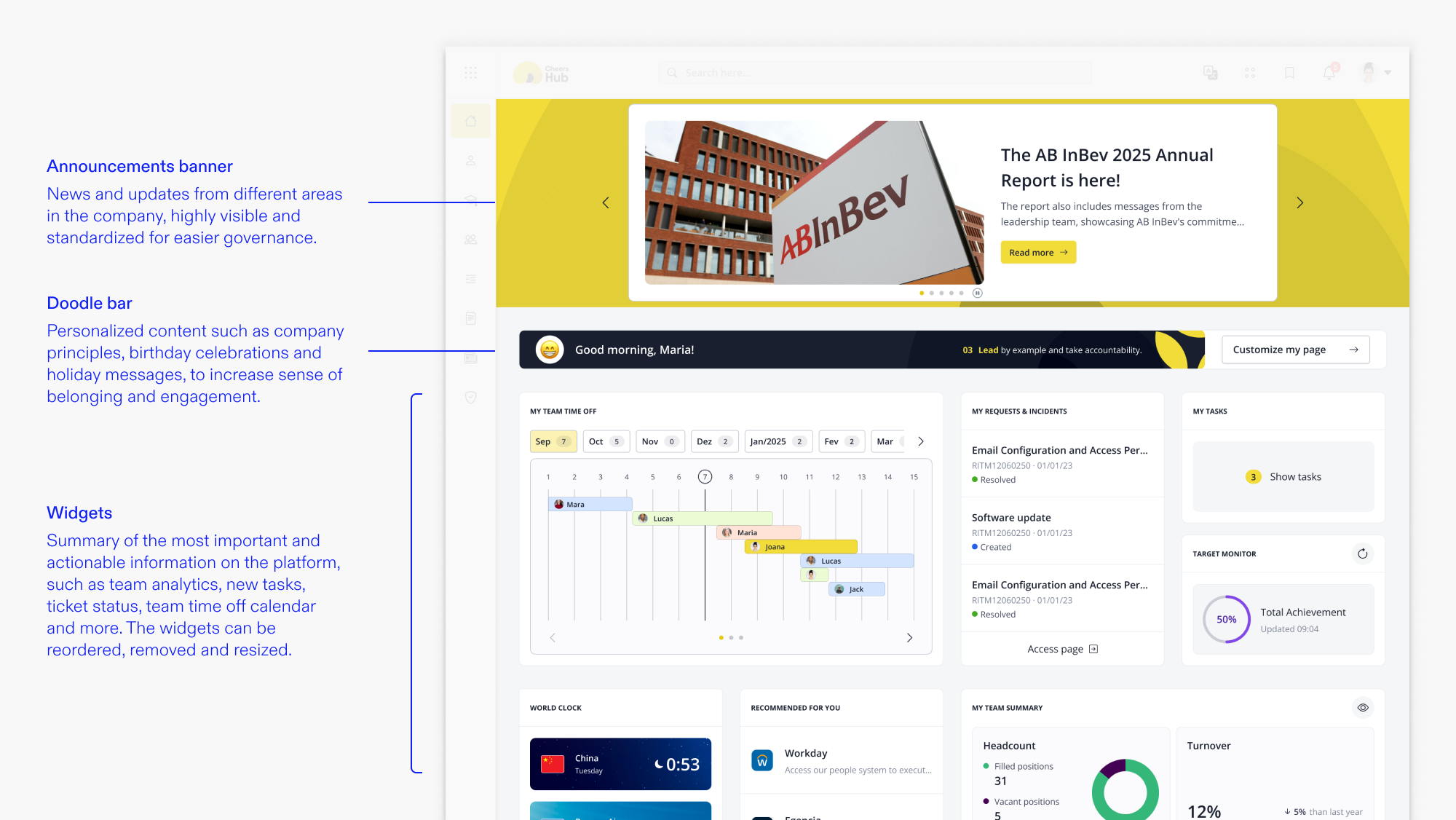
Home page after.
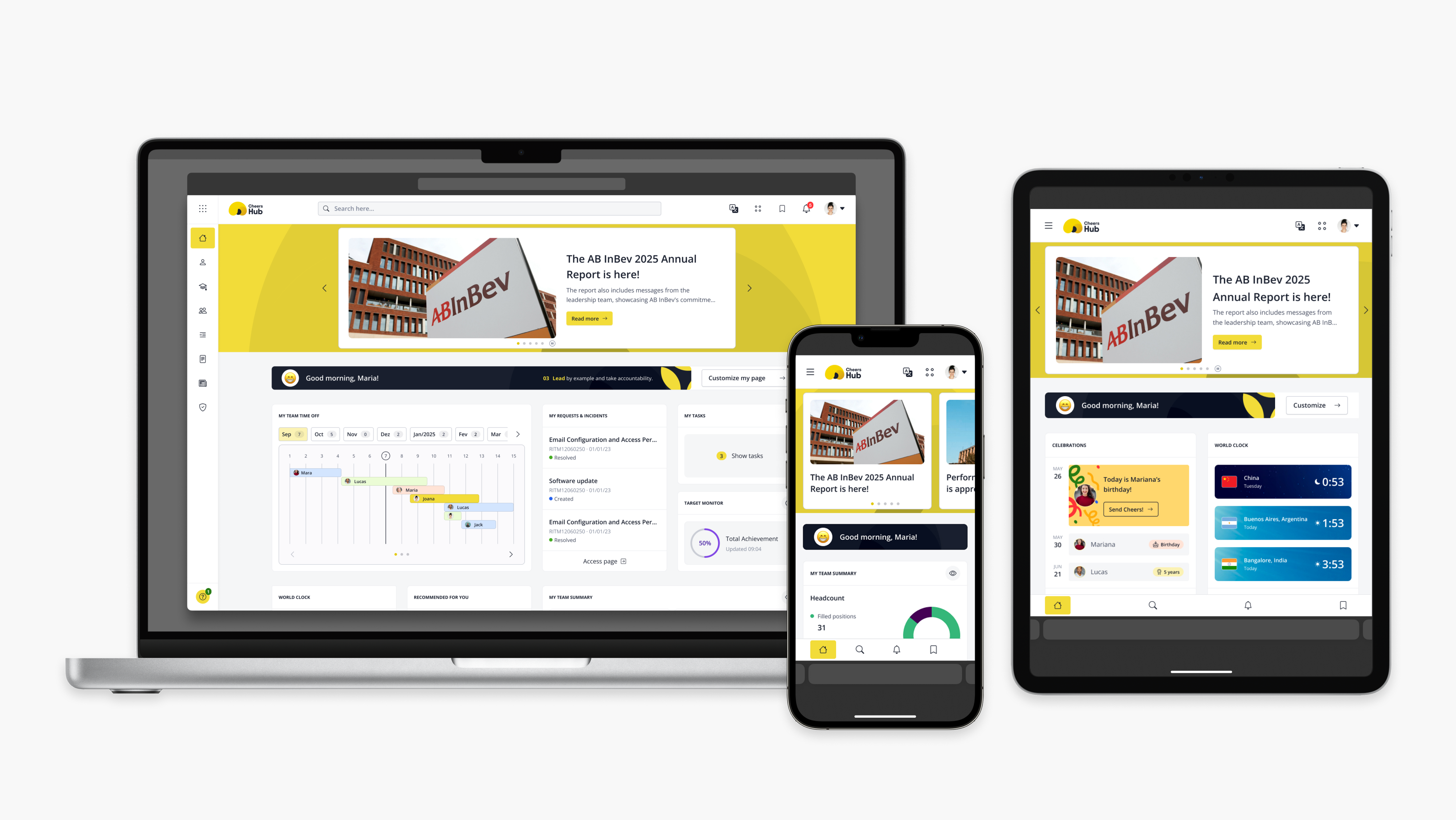
Desktop, mobile and tablet responsive versions.
GOVERNANCE
Challenge: Global needs versus local exceptions created inconsistent experiences and low trust, as regional customizations fragmented the platform. These issues made information hard to find, frustrated users, and reduced both engagement and adoption.My Solution: To reduce fragmentation while preserving regional flexibility, I centralized core flows and navigation, but allowed for exceptions through configuration and content governance. Localization guidelines ensured consistency at scale while still supporting local realities.
Design System
Challenge: The initial platform showed inconsistencies across typography, icon sizes, spacing, color palette, and component design. The heavy reliance on black further added visual weight, resulting in a strained user experience.
My Solution: To resolve this, I created a comprehensive Design System, shaped by the UX strategy, AB-InBev’s current design language, and key stakeholder input. The system brought balance and cohesion while reducing visual noise. Later, I also created documentation for the Design System, enabling the wider team to adopt it effectively and unlock its full potential.
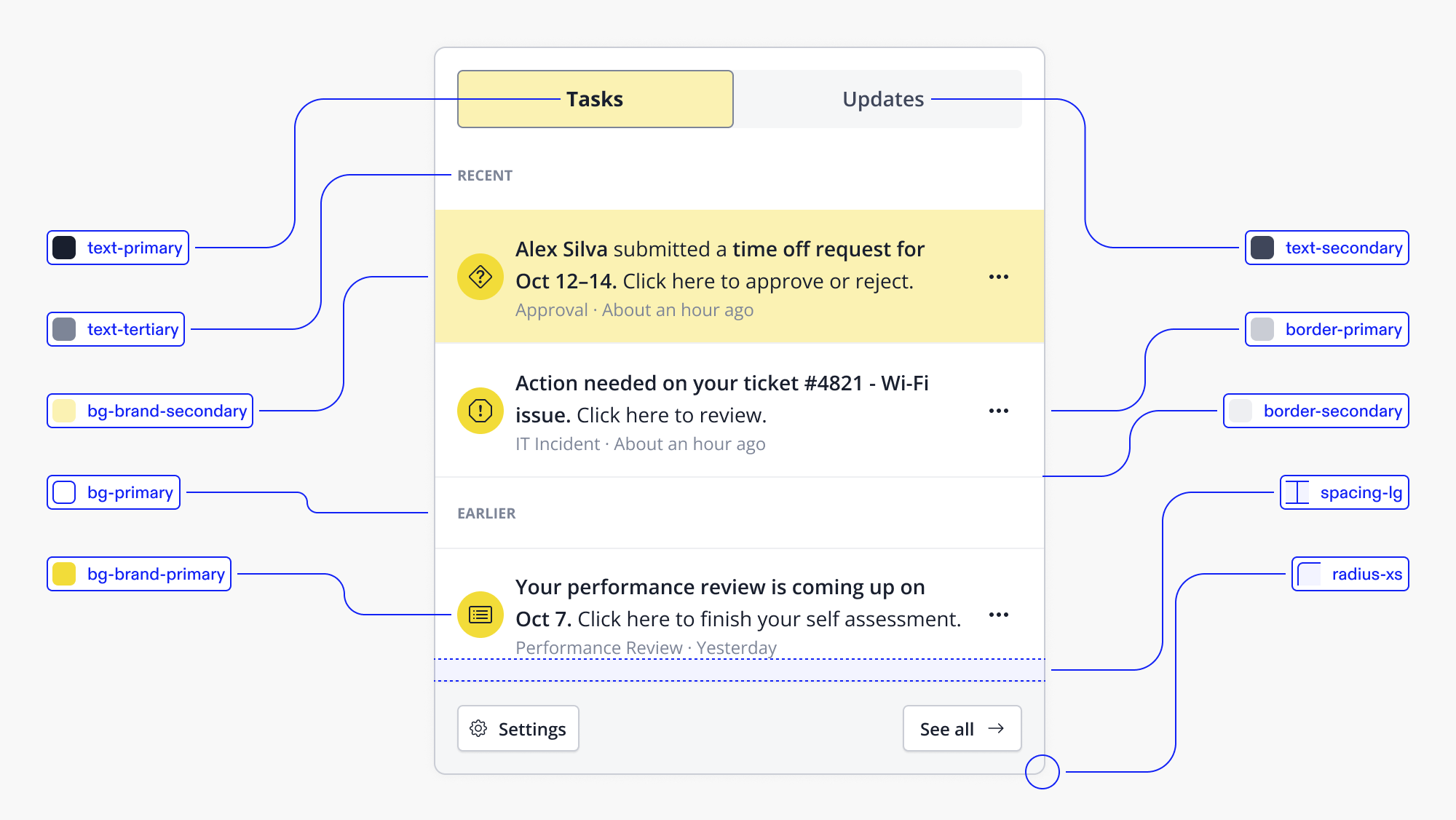
Application of color, spacing, and corner radius tokens.
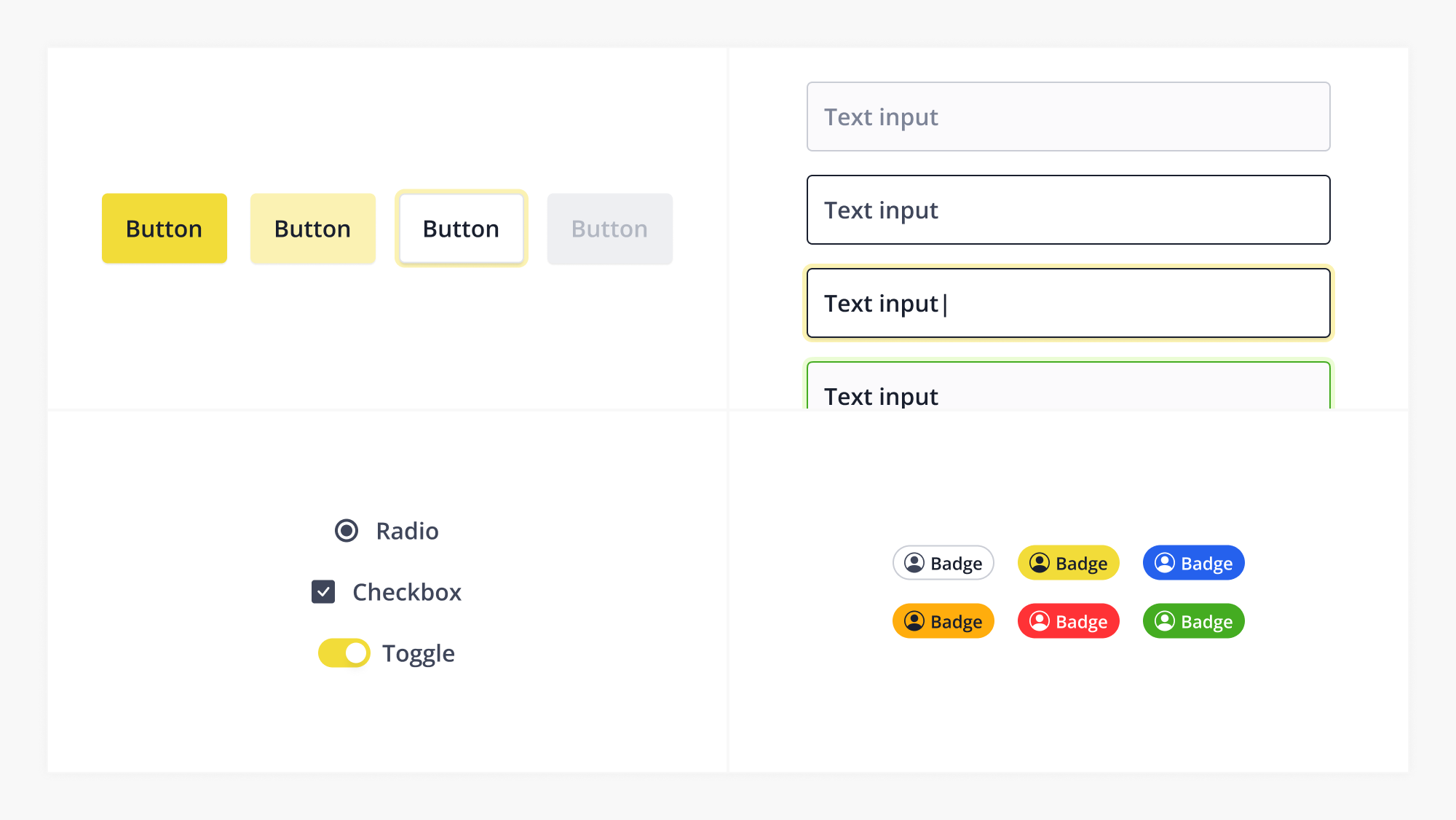
Examples of components.
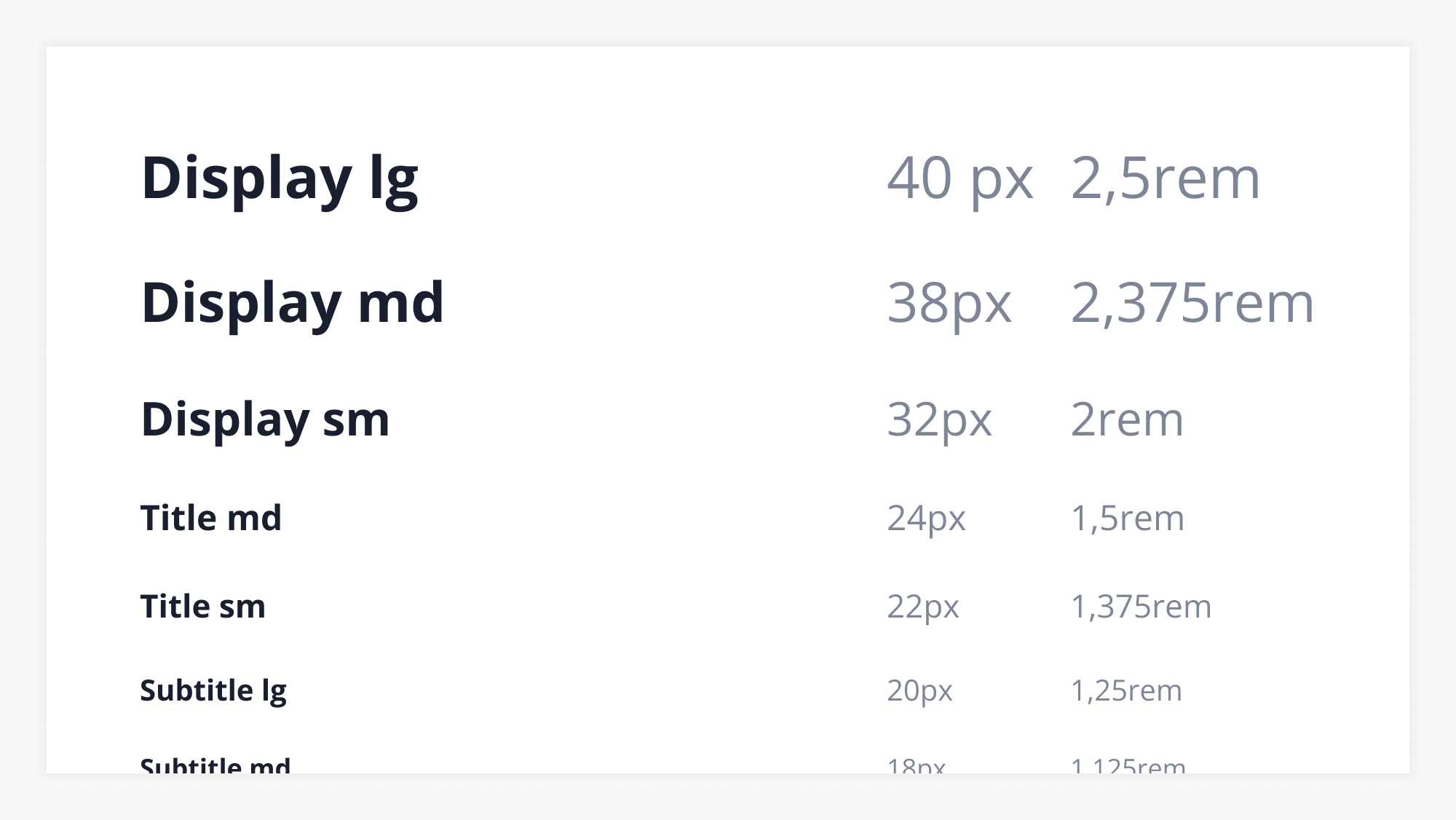
Typography styles.
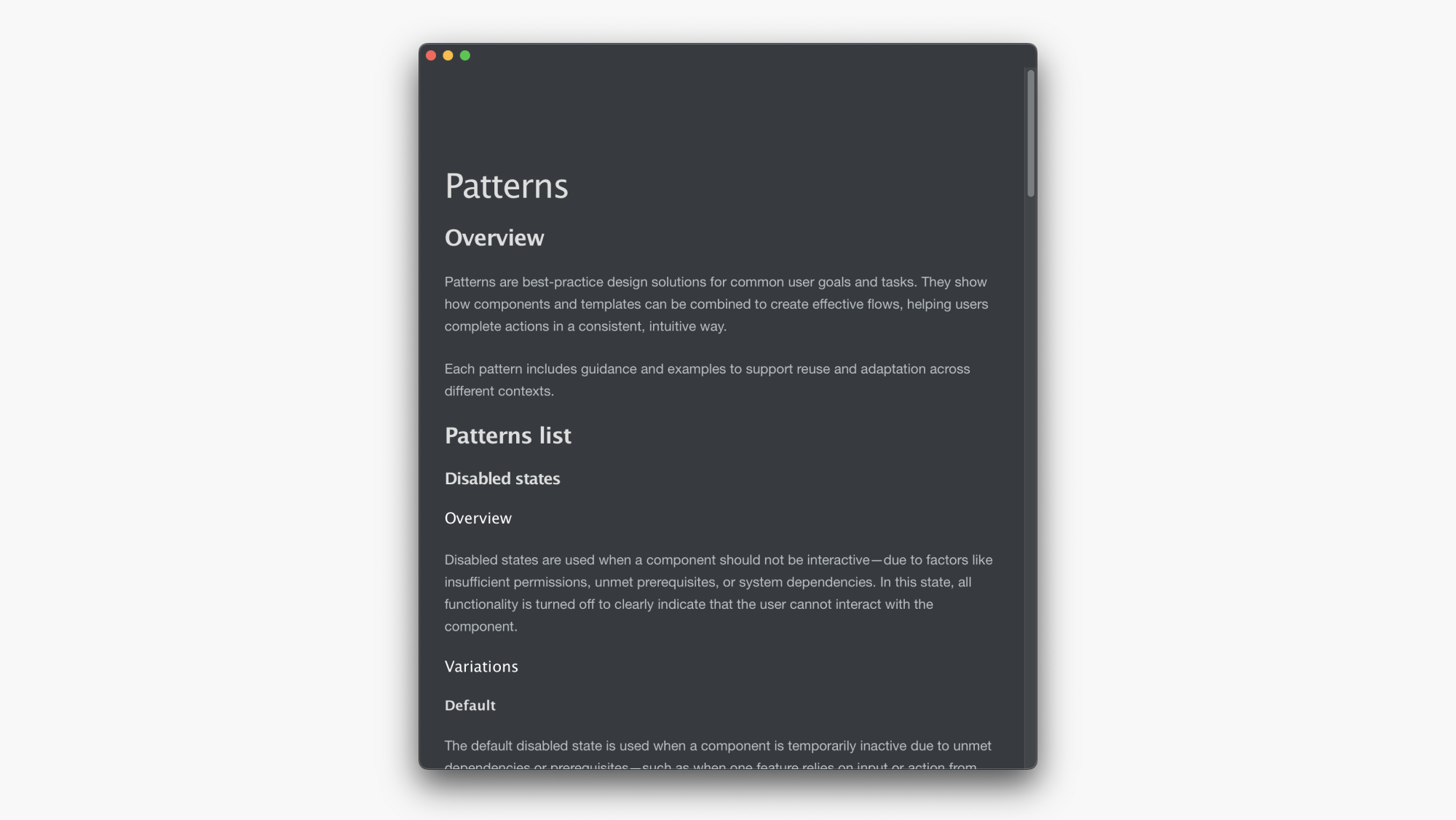
Excerpt of the documentation.
Selected features
Here is a selection of features fully designed by me, from discovery through developer hand off and QA, for mobile, tablet, and desktop devices.
Service Center & Knowledge Center
These core Cheers Hub features handle service requests and knowledge management in order to centralize processes and information for employees.Challenge: Through hybrid interviews and usability tests, I identified significant usability issues, including inconsistent experiences across countries, confusing navigation, redundant or misplaced features, poor labeling and translations, ineffective filters, rigid search behavior, and cluttered layouts. Together, these pain points created frustration, blocked discoverability, and discouraged employees from using the features.
My Solutions:
- Home page: Designed a mirrored experience using a side menu with categories/subcategories and cards, and renamed them as “Centers” for services and knowledge, to further indicate a clear starting point.
- Personalization & Engagement: Displayed only context-relevant requests and articles by default and improved bookmarks and feedback to strengthen trust and adoption.
- Flexible Search: Improved search engine to tolerate typos, and ensured filters only display relevant options with clear taxonomy;
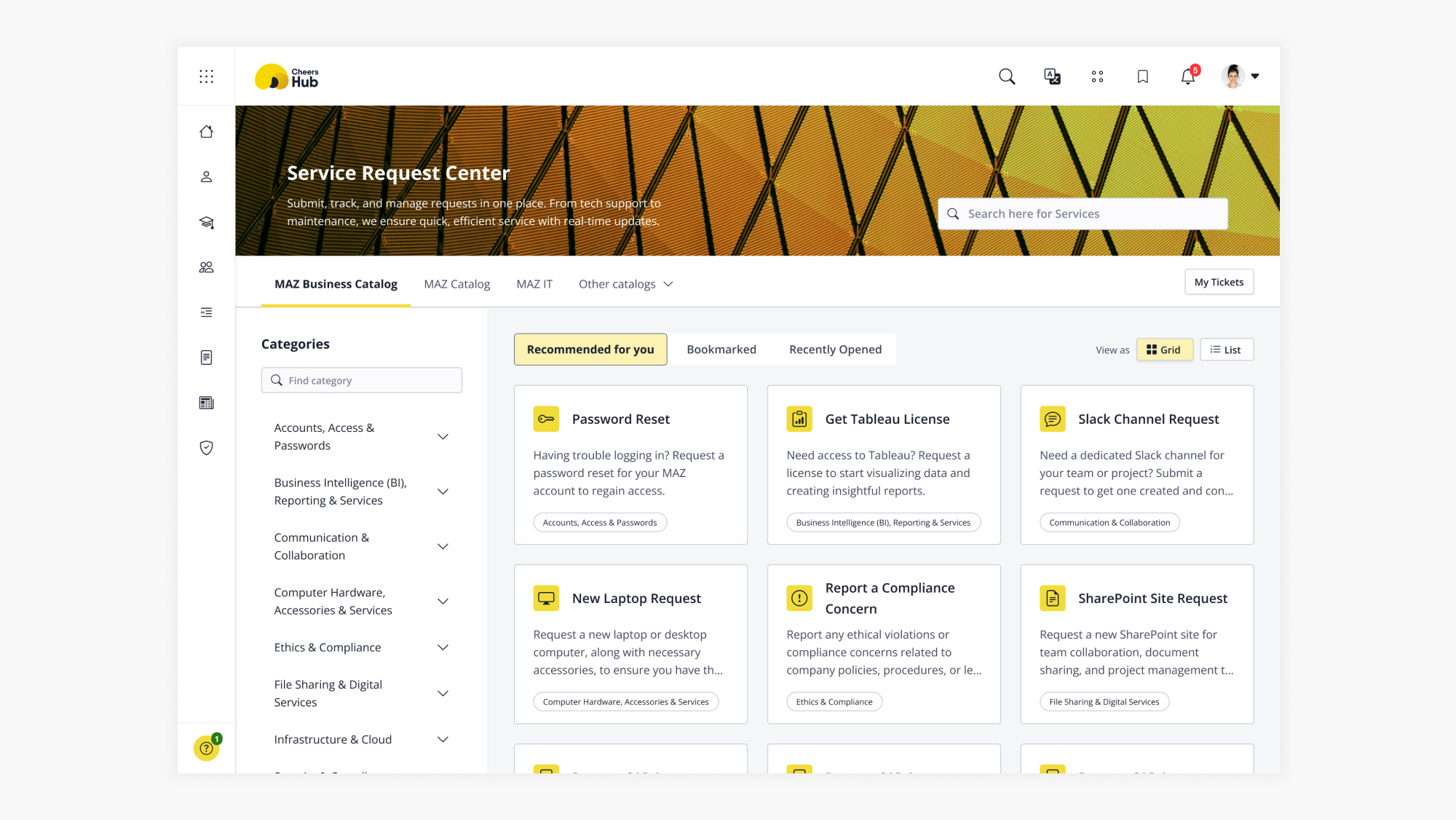
Service Center home page.
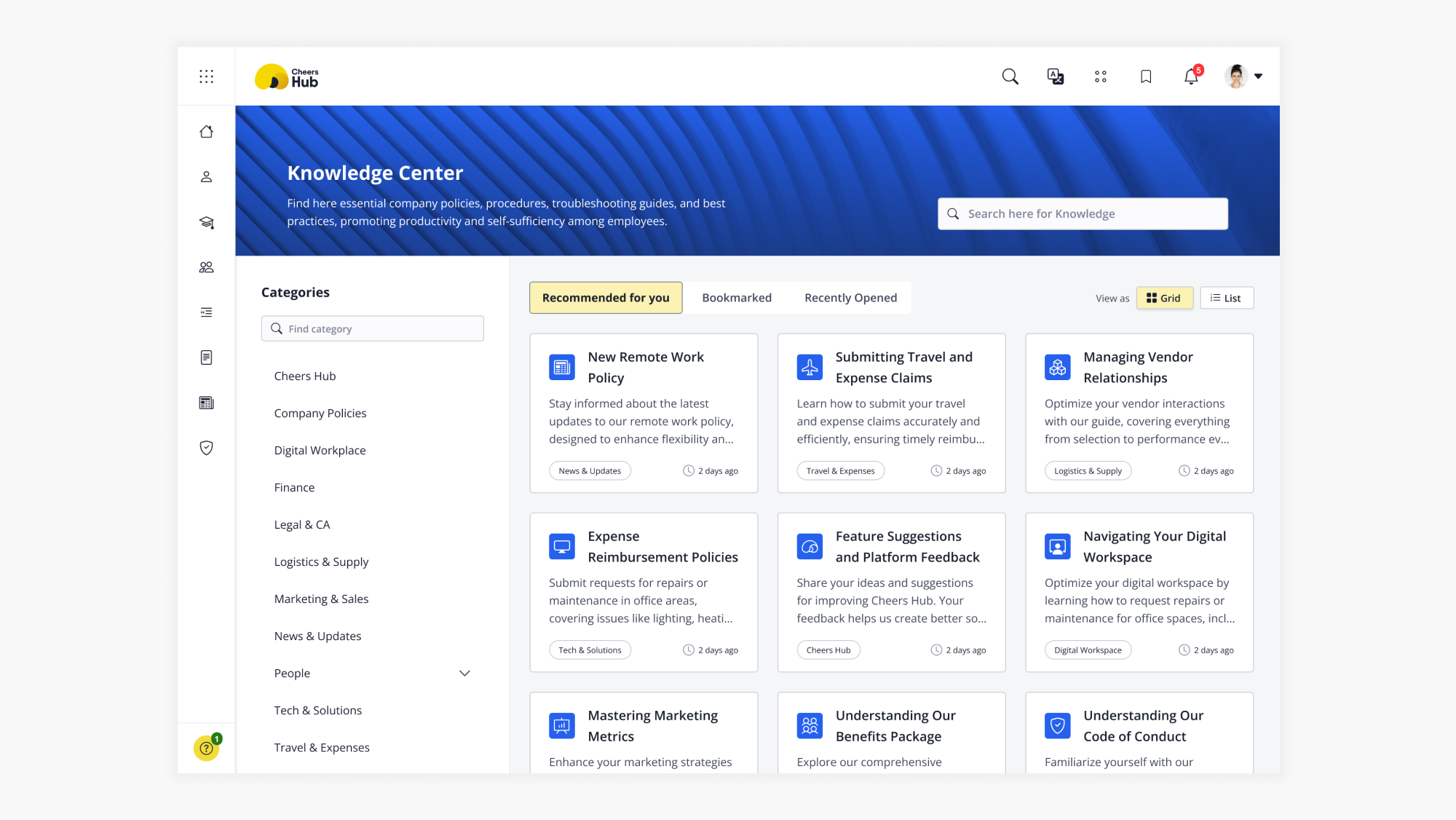
Knowledge Center home page.
- Knowledge articles & Request forms: Improved readability by positioning the main content in the forefront of the page, while leaving secondary items in strategic places to guide next steps;
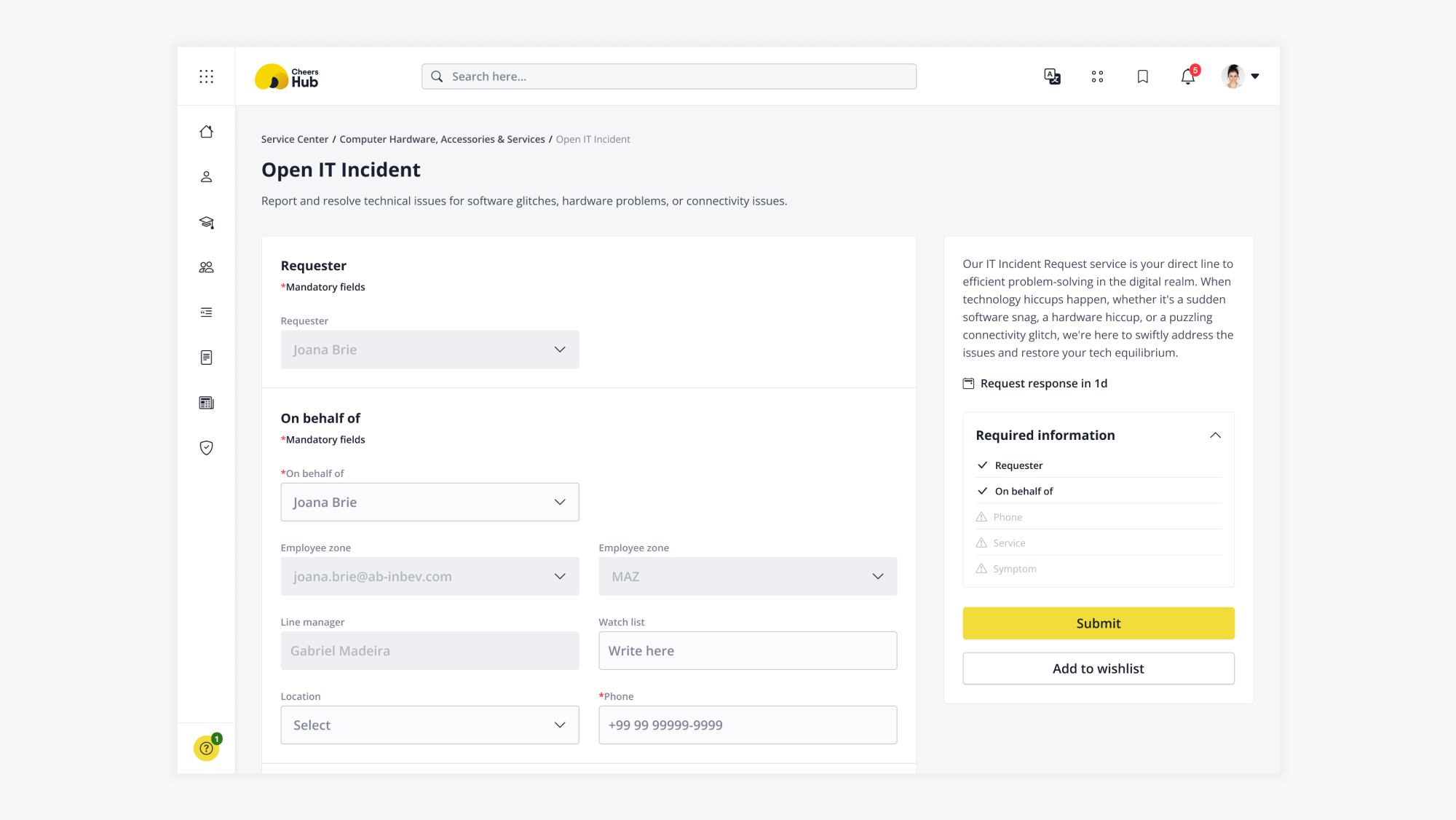
Service request page.
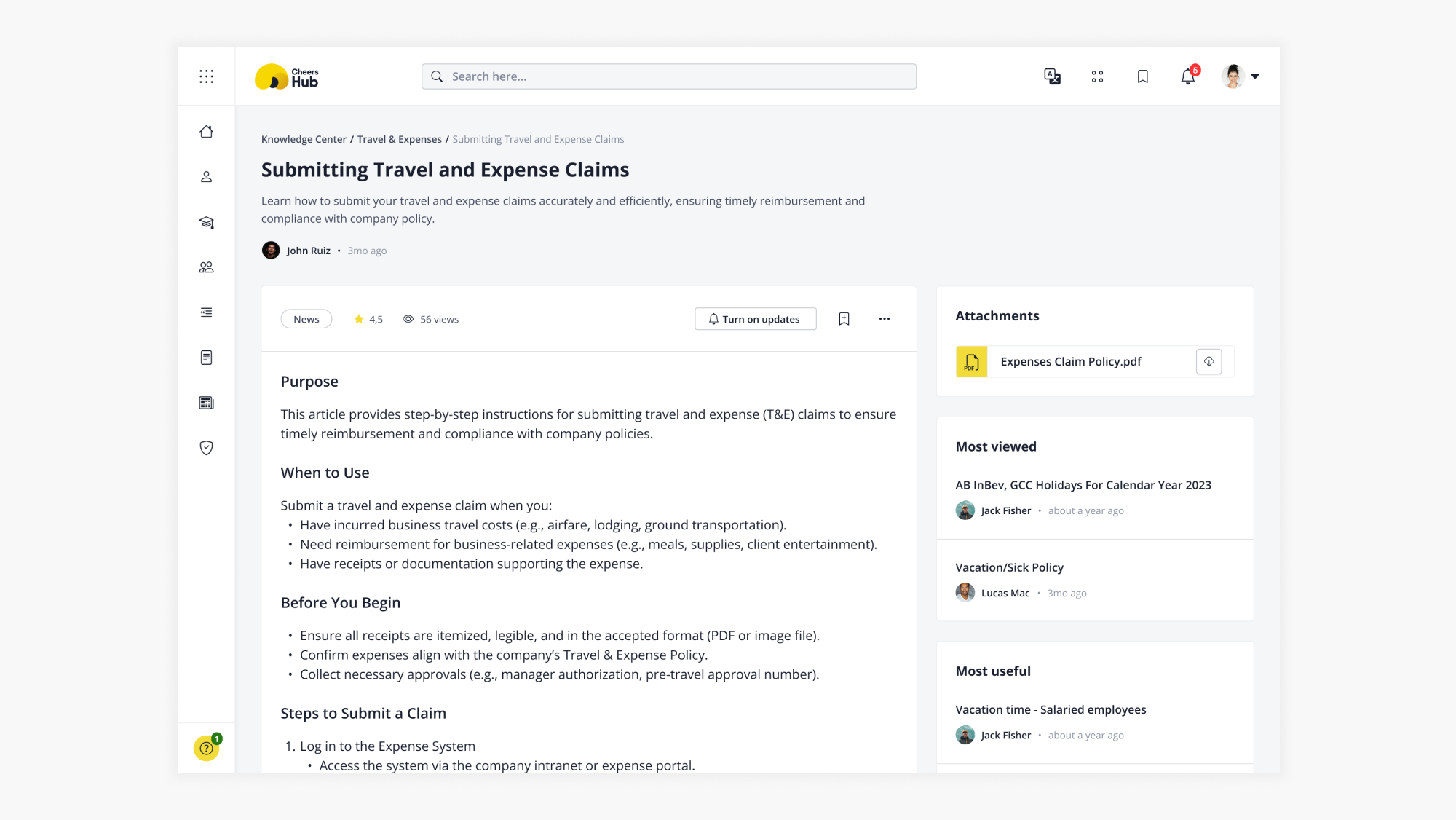
Knowledge article page.
my tickets
After a request has been submitted through the Service Center, the user is able to track it using the My Tickets page, and view more information by accessing the ticket details page.Challenge: During discovery, users have mentioned that the large quantities of information they have to browse through on a daily basis cost them a lot of time, and how they would like to find what they are looking for at a glance.
My Solutions:
- Strategic highlights: A snapshot summary of ticket counts provides a quick overview of their current situation, while colors differentiate ticket states and approval statuses at a glance.
- High level of customization: Users can choose and reorder columns to prioritize the data that matters most, and combine this with multiple filters to quickly narrow down results.
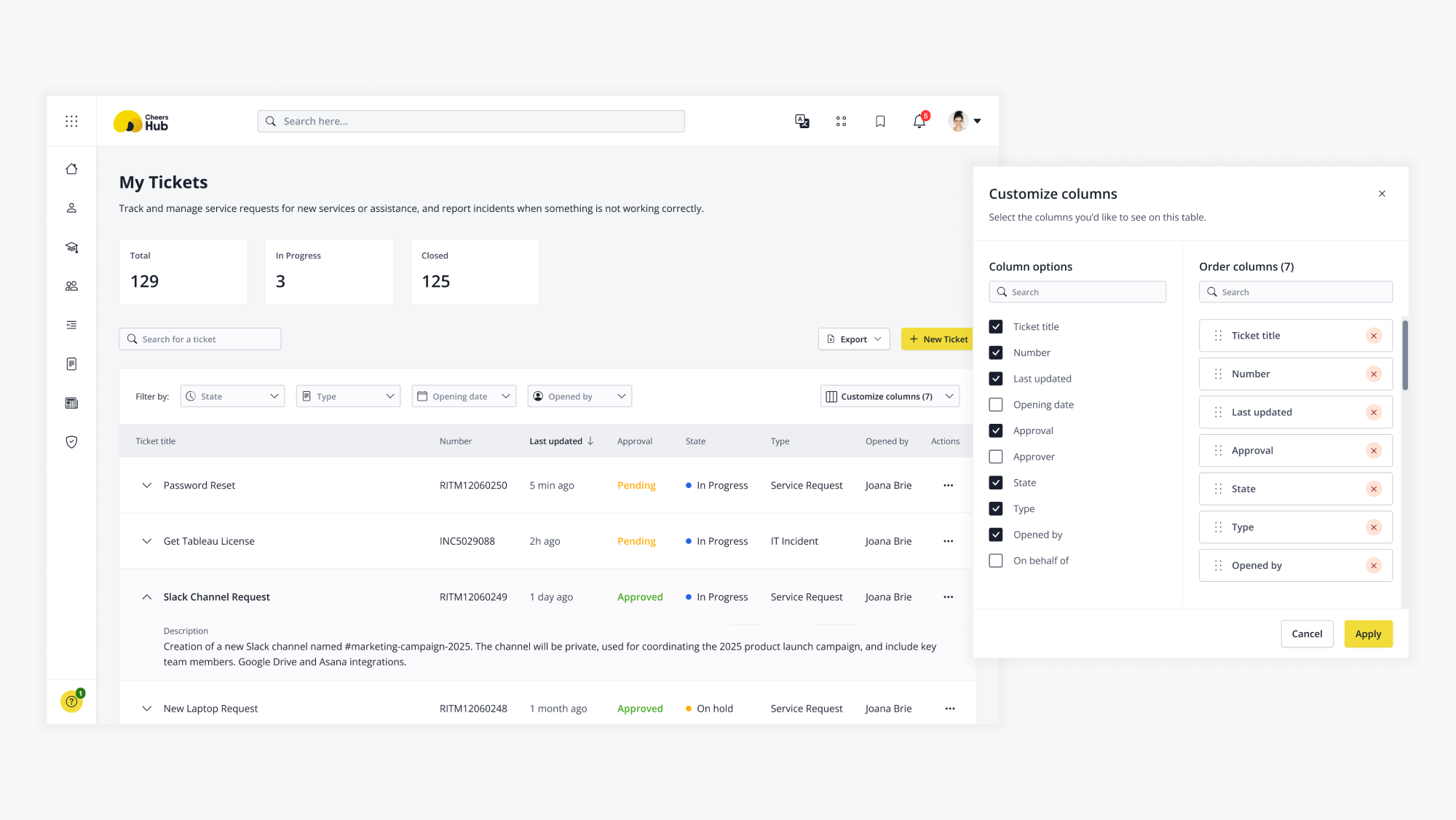
My Tickets page, customize columns modal.
- Simplified details: Ticket detail pages show only the most essential information by default, with the option to expand a section for deeper context.
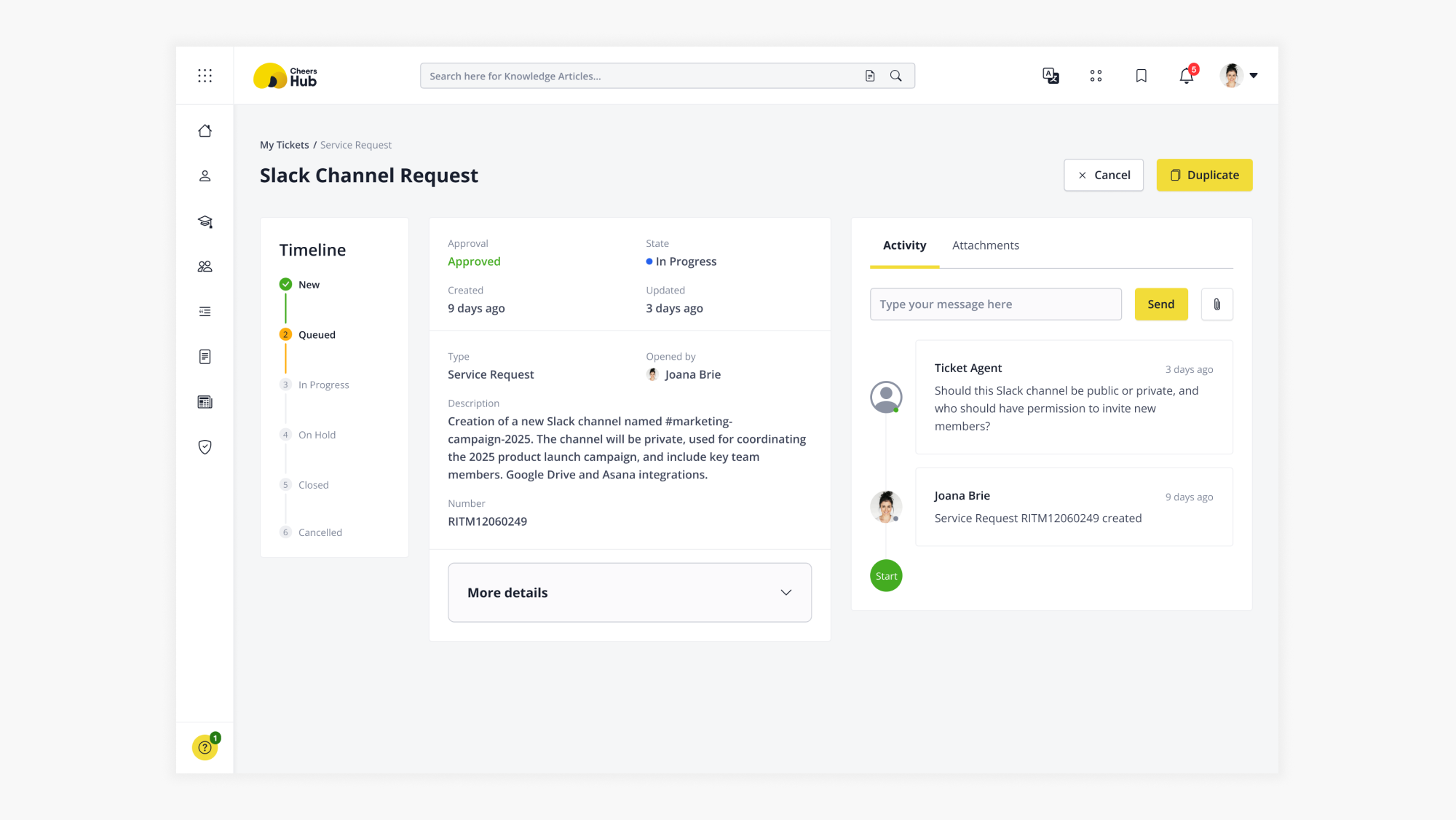
Tickets details page.
Team Dashboard
Another core Cheers Hub feature, Team Dashboard aims to be a hub for line managers to access employee data and insights about their team.Challenge: Initially, managers had to browse through multiple, scattered platforms to find important information about their team, so they often relied on People Business Partners for the task, which diverted their activities from strategic to operational.
My Approach: I conducted a series of interviews and facilitated a cocreation workshop to understand from managers which information they considered most relevant, and how they would like to access and visualize this information.
My Solutions:
- Relevant & Actionable Data: Prioritize the most requested information and pair it with contextual benchmarks (band, country, peer group) to make metrics meaningful.
- Customization & Flexibility: Allow managers to tailor widgets, indicators, and views to fit their team size and context.
- Clarity & Visualization: Simplify wording, avoid acronyms, and design charts and tables that surface key information clearly with summaries and color coding.
- Privacy & Control: Add features like hide/collapse for sensitive data to prevent accidental exposure and ensure managers feel confident using the dashboard.
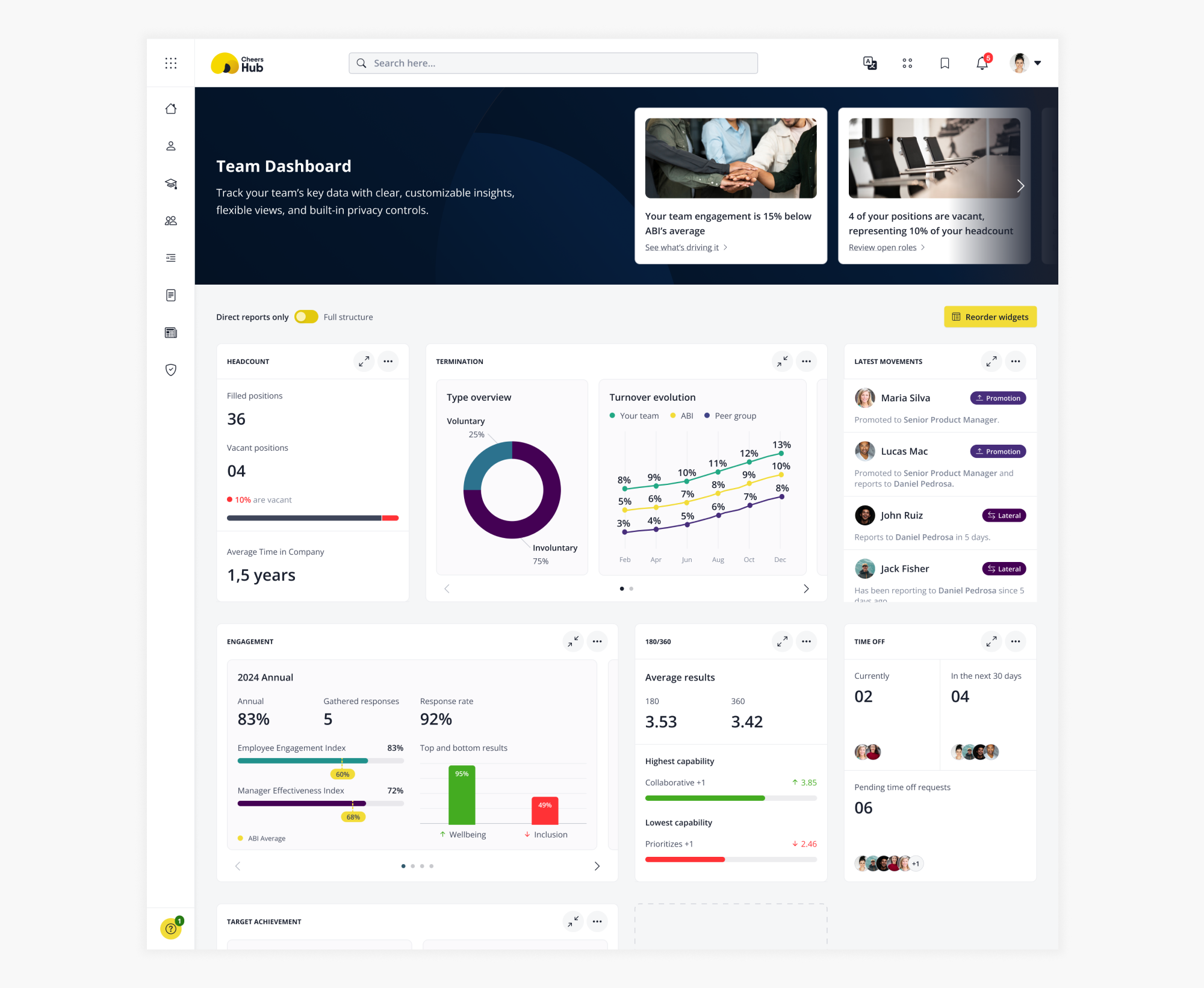
Team Dashboard page overview.
Impact
After over 2 years of continuous partnership with the client, Cheers Hub has not only facilitated access to company information and services, but has integrated processes, improved productivity and increased engagement, establishing a solid base for innovation and sustainable growth.
- Employee satisfaction: NPS grew from 17 in 2023 to 72 in 2025, with 81% promoters and only 8% detractors, supported by positive qualitative feedback.
- Global adoption: From an initial regional pilot in 12 countries, Cheers Hub is now present in 55 countries globally, with more than 50,000 active users and a monthly growth of over 200,000 accesses.
- Usability: Analytics tools indicate excellent results, with only 0.01% rage clicks, 1.31% dead clicks, 0% excess scrolling, and 0.75% quick backs.
- Scalable design: The Cheers Hub Design System has been extended to all platforms under People and Tech, enhancing consistency and user experience across the employee journey touchpoints, while increasing efficiency for development teams.
- Decommissioning legacy platforms: Cheers Hub has replaced fragmented, local systems with redundant features across multiple business units, allowing significant cost savings.
- Empowering People Business Partners: The delivered features reduce operational demands and enable People Business Partners to focus on strategic, high-impact activities.
Conclusion
Reflections on the work done so far, the key lessons learned, and the next steps I’d take to strengthen impact in future projects.
Learnings
- Designing for a global company means keeping core user flows consistent while allowing some local flexibility. Next time, I’d set these rules earlier to avoid fragmentation and build trust sooner.- By mapping the employee journey and focusing on the most important phases, I learned that clear priorities speed up adoption and deliver more business value. In future projects, I’d link roadmap choices more directly to measurable results.
- Starting the Design System early was key to achieving consistency, efficiency, and scale. I’d now make systems thinking part of discovery from the start, treating it as a core strategy.
Next steps
- Strengthen the project’s metrics culture to track success on the feature level through efficiency, adoption, cost savings, and productivity.- Dedicate more resources to Design System ops to scale consistency, governance, and efficiency faster across all People & Tech platforms.
- Embed AB-InBev’s evolving AI Assistant and GenAI into Cheers Hub to help employees find information instantly, complete processes seamlessly, and unlock actionable insights, while automating routine tasks, improving engagement, and freeing teams to focus on higher-value work.